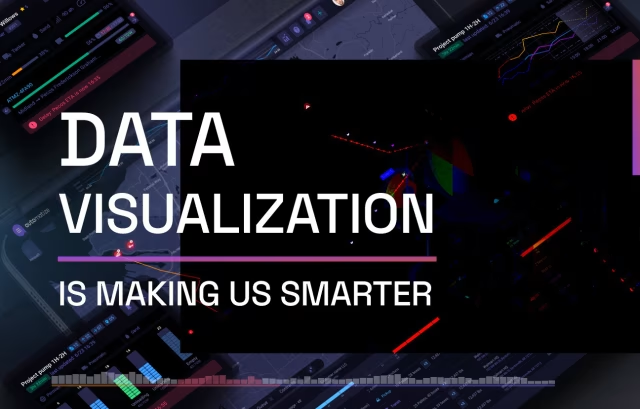
Map data visualization, or geospatial data visualization services, involve the use of maps to represent and display various types of data, making it easier to understand and analyze complex and unwieldy amounts of information. We often leverage geographic information systems (GIS), mapping software, such as MapBox or ArcGIS, and data visualization techniques to create interactive maps that provide meaningful insights.
Map Visualization Agency
Map designers are a special breed in the data visualization community. To create an interactive map that is both able to convey vast amounts of information, immediately intuitive for users in terms of what is possible and able to provide usable insights is the trifecta of map visualization teams. At Fuselab we design map data visualization for various industries, including retail, logistics, healthcare, real estate, environmental science, transportation, and urban planning.
Our Map Visualization Design Process
To create a map visualization doesn’t happen in a vacuum, we have very specific process that begins with solid user research and requirements gathering. These foundational processes set the stage for a design process based on verifiable user inputs and agreed to goals.

User Research
- Define the goals of the dashboard
- Identify the target audiences
- Develop specific personas
- Begin creating use-cases

Requirements
- Identify the stakeholders
- Prioritize the requirements
- Document the requirements
- Publish findings for design team

Technical Limitations
- Data complexity
- Database size
- Real-time data updates
- Data accuracy

Explorations & Data Visualization Experiments
- Define the goal of the experiment
- Begin wire framing process
- Create the visualization

Test & Refine
- Evaluate the criteria for success
- Execute the test
- Refine and repeat
Types of Map
Visualizations
All of the different types of map design make for the most all-inclusive ways to present vast amounts of data efficiently and effective for multiple audiences.
How to know what types of digital maps to deploy for what audiences is entirely contingent on regular and repetitive user testing. As a rule, “what works today doesn’t mean it is the right choice tomorrow or a year from now. This space is not just constantly evolving, it is also constantly improving.

Heatmap data visualization is exactly what it sounds like, and even for those presented with this kind of map, it is immediately obvious the intent behind it. Heatmaps allow for simple and effective interaction, such as zooming in and out to display specific data layers.


An administrative map usually involves some kind of real-time monitoring of data. In this case, the map to the left depicts the movements of an entire fleet of trucks, their trip times, profitability of each trip, average vehicles speed, and about a million other datapoints.


A statistical data visualization map is a visual summary of data according to user selected filters, such as region, time, and/or demographic. Understanding the buying habits of your target market is just one of many uses for this kind of map.


A trajectory map is a type of map-based data visualization that is specifically designed to display the movement patterns of objects, individuals, and/or entities over a specific period of time. It is a powerful tool for understanding the spatial-temporal aspects of data, making it valuable in transportation, logistics, epidemiology, wildlife tracking, and a whole lot more!


Every single bubble typically represents a specific location or geographical area in a bubble map, and the size of the bubble usually corresponds to a particular data value associated with that location. These maps are particularly useful for visualizing and comparing data across different regions or locations.


Geovisualization techniques are most commonly found in the back of airline magazines, or possibly in large airport digital screens depicting arriving and departing flights from specific cities or airports. Additionally, these maps can be used with time-sensitive data to depict specific timing of flight trip progress.


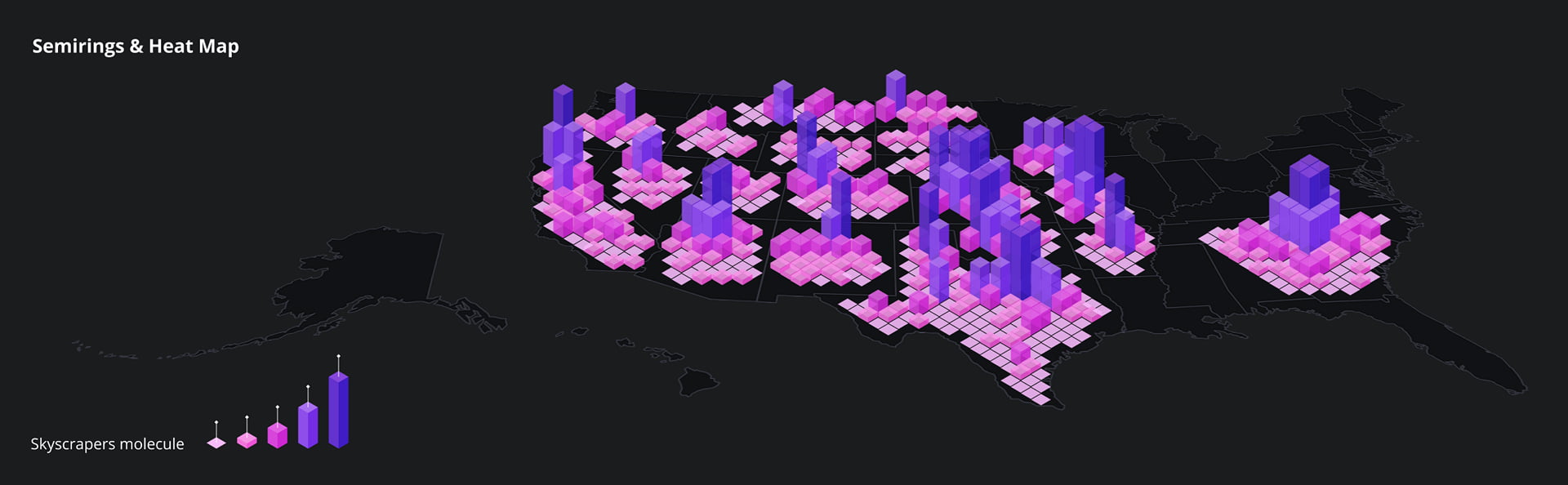
A spike-style heat map is a type of data visualization that represents data points as spikes, typically to show the density or distribution of a specific phenomenon that is specifically attributed to a geographic area. This visualization is useful for understanding spatial patterns and trends in data.


A dynamic interactive map might be one of the most interesting and useful forms of data visualization. This map-based tool allows users to explore and interact with data in real-time or through user-driven interactions. These maps are designed to provide a highly engaging and informative experience by enabling users to manipulate and explore data visually and to continuously dig deeper into the experience.

Advantages
of Geospatial
Visualization
Geospatial map visualization offers a powerful tool for businesses and organizations to gain valuable insights from spatial data, facilitating informed location-based decisions.


Why Are Maps Important in Data Visualization?
Map-based data visualization can be on the most powerful tools for communicating complex data-driven stories. They make it easier to convey information to a broad audience, whether it’s for educational purposes, news reporting, or policy advocacy.
In fields like business, public health, and disaster response, efficient resource allocation is critical. Maps help organizations allocate resources where they are needed most effectively.


Interact
With the Map
Interactive map data visualization are often dynamic maps that use animation to show changes over time. This can be particularly useful for visualizing temporal data, such as the progression of a storm on a weather map or the movement of vehicles on a transportation map.


Configuration

Layering
Our Map Visualization
Services and Solutions

Map Dashboard Design
Immerse yourself in an intuitive and visually appealing map dashboard that offers a tailored experience. Our expert designers craft interactive interfaces that guide you effortlessly through the world of spatial data. Get ready to explore and uncover the hidden gems within your information.

Interactive Map UI/UX Design
Engage with your data like never before, and say goodbye to challenging navigation and hello to an interactive user experience like no other. Our map UI/UX designs bring your data to life, allowing you to seamlessly explore and interact with your visuals. Let the data tell its story and open new doors for understanding and informed decision-making.

GIS Design
Our geographic information system design services go beyond simple mapping. We delve into the world of geographic data analysis and visualization. Uncover valuable patterns and relationships within your data, enabling you to make data-driven decisions that drive success.

Dynamic Map Layers
Unveiling the richness of your data experience reveals the power of overlaying multiple datasets on a single GIS visualization map. Dynamic map layers reveal intricate relationships and patterns, providing a comprehensive understanding of your information. Unleash the potential of your data with this multi-dimensional approach.

2D & 3D Map Visualization
Watch your data come to life through our exceptional 2D and 3D visualization services. Gain a deeper understanding of your information with seamless transitions between dimensions. Dive into the details and see your data from new perspectives.

Data Integration
Our data integration services seamlessly blend data from multiple sources, creating a unified view for analysis and visualization. Whether it's importing CSV files, spreadsheets, or databases, we ensure a smooth process. Get ready to explore the full potential of your data, all in one place.

Advanced Data Filtering
Our advanced data filtering capabilities allow you to refine your analysis and focus on the most relevant insights. Discover hidden gems within your data and gain a deeper understanding of your information.

Report Generation
Create visually compelling reports that combine maps, charts, graphs, and text to communicate your data-driven insights effectively. Tell a captivating story that resonates with your audience and drives informed decision-making. Let your reports become your secret weapon.
Map Visualization Portfolio




Data Visualization Map
Design Examples
The amount of styles and menu options when it comes to data visualization maps the list of possibilities just keeps growing, which means our map data visualization agency needs to continuously seek out new ways to illustrate data for our clients.
Incorporating GIS mapping graphics along with client specific data can produce unexpected insights and a digital map experience that is as engaging as it is informative.

Map Layers
Below is small list of map layers types, not an exhaustive list, but these are some of the most popular and useful types of graphical layers that are used in map data visualizations.

Slots
Slots is a commonly used visualization type for geospatial data map application design. Slots is a term used to represent a layer that is a combination of images associated with UV map (U represents the horizontal axis and V represents the vertical axis).
Heatmap
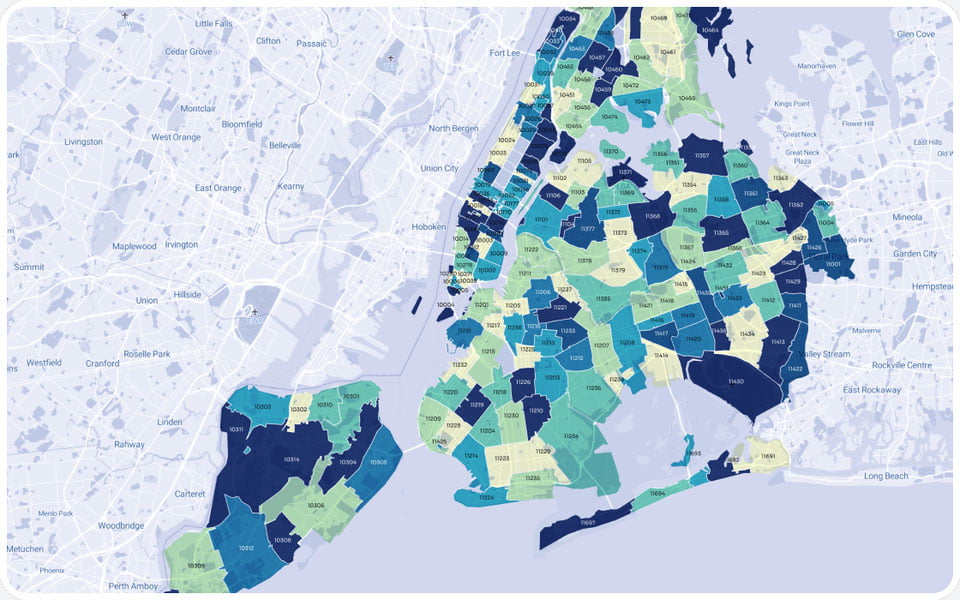
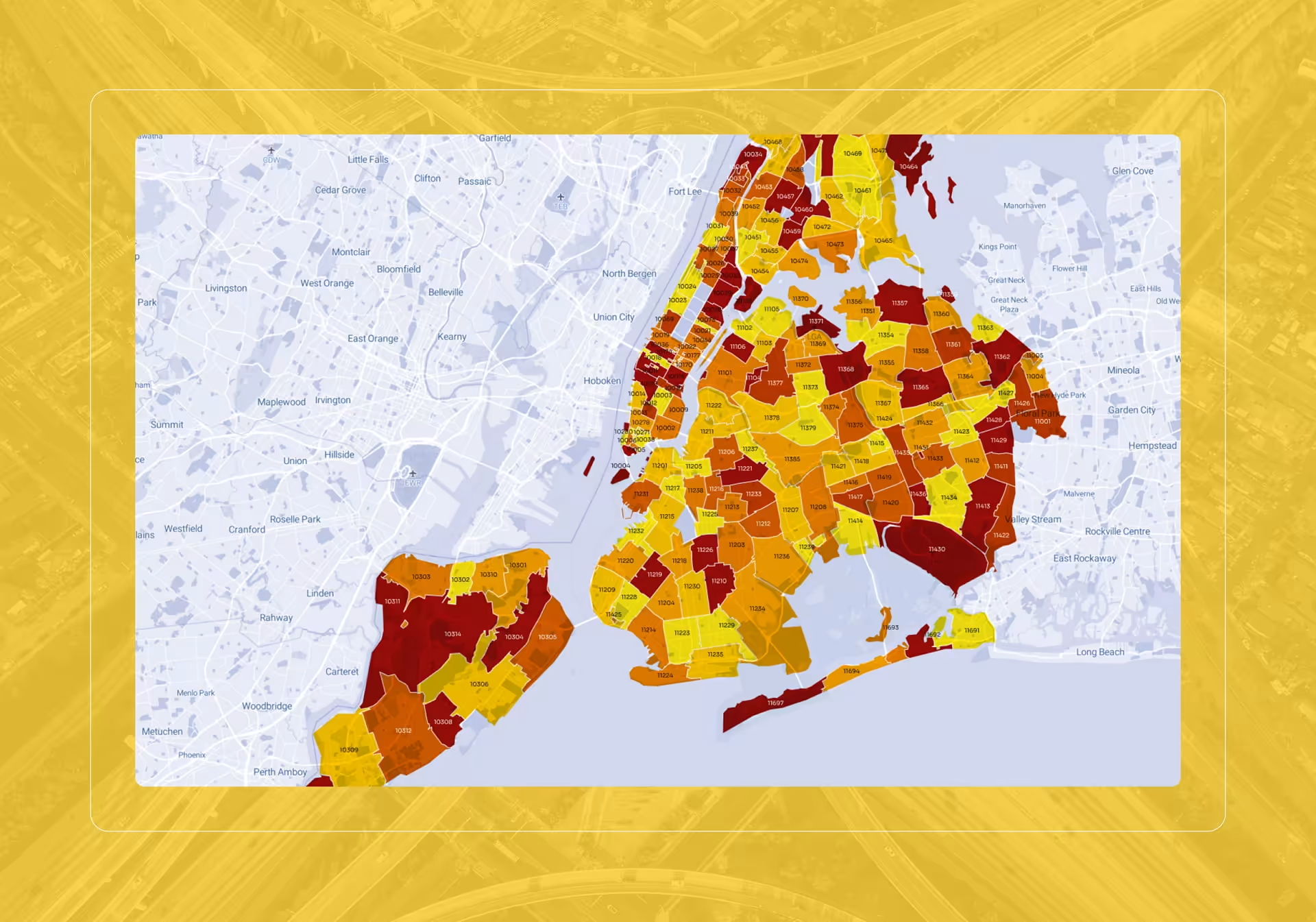
Sometimes you may hear the term choropleth map, which is just another way to say heat map, which is essentially the blending of colors to applied regions on a map to indicate the changes taking place according to a specific data type, several data types.

Dots
A dot map visualization creates clusters of dots to indicate specific data points or events on a geographical or spatial map. Typically, each dot symbolizes a single occurrence or unit of data, such as a specific number of people, events, or objects related to a particular location.
Spikes
A map data visualization company has a plethora of visual choices to choose from, and the choosing of each visual depends heavily on the type of data selected. It’s the combination of the data type and the graphic elements implemented determine the possibility of delivering a successful UX.


Traffic
Possibly the most recognizable form of map visualizations is highway and road traffic maps, often using simple red, yellow, and green to show the level of congestion and free flowing traffic across a particular region or network of roadways.
Taking Map App Design
to the Next Level
Fuselab Creative has been working with the State of California’s Health Care System to reimagine how to make use of their health care beneficiary data. We were required to use PowerBI (PBI) in our efforts, but were able to increase the level of sophistication of PBI by creating our own custom data visualization modules.

Country Statistics
Comparing health-related data across the world allows for governments and large health organizations combat disease and epidemics, among countless other statistics that help protect the public health.

Map Visualization Tools And Technologies We Use
The list below is constantly evolving, as we develop our own software, such as FuseDash, as well as adding and deleting our primary software suite we rely on to experiment with the most effective tools to create effective data visualizations.

Google Earth

Someka Heat Maps

Tableau

OpenHeatMap

InstantAtlas

Polymaps

Mapbox

ESRI

Sisense

FuseDash

Power BI

Custom App
Industries We Love to Design
Interactive Maps For

Healthcare applications and disease map data visualization projects have now become more than 50% of our current project workload. Working on behalf of better health and better decision making for health providers could not be more inspirational to all of us at Fuselab.

Logistics and telematics companies build platforms to move people and goods from one place to another. However, to properly build these platforms, design agencies like Fuselab must acutely understand how a routing map data visualization is used by stakeholders to become more efficient, increase profit, and the list goes on and on.

Travel map app UI design is focuses heavily on mobile and tablet environments, as the expectations from users is constantly growing, including access to real-time traffic and public transportation data along with interesting tourist-related data. The UI needs to be 100% intuitive regardless of the users technical savviness or type of device being used.

Among the many critical services provided by city and county governments is the need to devise sophisticated plans to manage the fallout from natural disasters. A data visualization flood map can make the difference between a city brought to a halt or a city that is able to rise above the impact of a major flood.

Understanding the growth of communities and urban sprawl can best be depicted using data map visualization techniques. Using these maps and the corresponding historical data also provides a way to develop predictive analytics data to help circumvent future challenges and plan for the eventual changes taking place in particular regions.

Map data visualization can play a crucial role in helping users navigate the vast virtual reality geospatial worlds of the Metaverse. Just as maps are essential for finding your way in the physical world, interactive maps could guide users through virtual spaces, showing real-time locations, landmarks, and routes to their destinations.
Contact Us
Fill out the form!
Frequently Asked
Questions
Fuselab Creative has been creating user-friendly and visually appealing digital interfaces for over a decade, and we still feel like we've only touched the surface of our potential.
What exactly is map‑based data visualization, and when is it more useful than traditional charts or tables?
Map data visualization, or geospatial data visualization, uses maps to represent and display data tied to specific geographic locations, making complex spatial information easier to understand and analyze. It’s more useful than traditional charts when location is a critical factor—for example, when analyzing demographic trends by region, tracking disease outbreaks, optimizing supply chain routes, or understanding customer distribution patterns. Maps excel at communicating data-driven stories to broad audiences because they provide immediate spatial context that tables and charts cannot, making them particularly powerful for resource allocation, disaster response, urban planning, and public health communications. They’re the premier communication vehicle when you need to convey community exposure rates, population density, regional performance, or geographic patterns that impact decision-making.
What kinds of map visualizations do you support?
We create comprehensive map visualization solutions, including interactive maps with real-time data layers, 2D and 3D visualizations with seamless transitions between dimensions, heat maps (choropleth, density, and geographic heat maps), and bubble/proportional symbol maps. Our work includes GIS-based visualizations using advanced mapping software, routing and logistics maps with GPS integration, demographic analysis maps, and specialized applications like disaster response flood maps and healthcare service accessibility mapping. We design map visualizations for retail, logistics, healthcare, real estate, environmental science, transportation, urban planning, and public health across web and mobile platforms. Our solutions range from simple location-based displays to complex multi-layered visualizations with overlapping datasets that reveal intricate relationships and patterns.
How do you choose which type of map is appropriate for my data?
We base our map type selection on two critical factors: the nature of your data and the most accessible, intuitive strategy to convey that information to your specific audience. Our process begins with a comprehensive discovery to understand your data relationships, business objectives, and user decision-making workflows, then we match these requirements to visualization techniques that best highlight your spatial patterns. Heat maps work best for showing density and distribution (like population concentrations or disease prevalence), choropleth maps excel at regional comparisons, and layered interactive maps are ideal when users need to explore multiple data dimensions simultaneously. We think of ourselves as strategic advisors who translate your business questions into visual solutions rather than forcing your data into predetermined formats.
What data formats do you accept for map visualization?
Our data integration services accept CSV files, spreadsheets, databases, GeoJSON, API connections, and various geospatial data formats compatible with GIS systems. We seamlessly blend data from multiple sources to create unified views for analysis and visualization. During the discovery phase, we compile a comprehensive list of your data sources and identify the most effective methods for collection and integration. We work with location data in multiple formats, including coordinates, addresses, and spatial boundaries, and can process both structured and unstructured geospatial datasets.
Do you handle data cleaning, normalization, and geocoding if our data is messy or incomplete?
Yes, we provide comprehensive data preparation services, including cleaning, normalization, and geocoding, to transform your data into map-ready formats. Our process includes identifying and handling messy location data—for example, filtering out invalid entries like “in the cloud” or “Interstellar Transport Station” that can’t be geocoded. We use tools like Mapbox Search API and other geocoding services to convert addresses into precise geographic coordinates (GeoJSON format) that work seamlessly with mapping platforms. Our data integration ensures smooth processing whether you’re importing disparate sources or dealing with incomplete geographic information.
Will the map visualization be interactive or static?
We specialize in dynamic interactive maps that allow users to explore and interact with data in real-time through user-driven interactions, providing highly engaging and informative experiences. Our interactive maps enable users to manipulate and explore data visually—including zooming, panning, filtering layers, drilling down into granular details, and customizing views based on their specific goals. We can also provide static map images when needed for presentations or reports, but our strength lies in creating maps where users can continuously dig deeper into the experience. Interactive features include real-time hover capabilities, time-based animations, multi-dimensional layer controls, and the ability to change geographic scales from global to neighborhood-level views.
How do you ensure the accuracy and integrity of the data shown on the map?
We leverage reliable geospatial platforms like Mapbox and Esri that maintain continuously updated location data with over 100,000 updates per day to ensure accuracy and detail. Our rigorous testing processes include functionality, performance, and data validation testing to identify and address any issues or inconsistencies before launch. We conduct multiple integration checks to verify that data from various sources integrates correctly and displays accurately on the map, and we implement data validation procedures during the geocoding and normalization process. Our approach includes establishing clear data quality standards during discovery and maintaining comprehensive documentation to ensure data integrity throughout the visualization lifecycle.
Can the map design be customized to match our branding and overall UI/UX of our product or website?
Yes, map visualizations can be extensively customized to match your corporate identity, brand colors, typography, and overall design language. Platforms like Mapbox offer the most extensive customization capabilities in the industry, allowing us to control all visual aspects of a map, including base layers, color schemes, iconography, and interactive elements. We design custom map styles using tools like Mapbox Studio that integrate seamlessly with your product’s UI/UX, ensuring consistency across all digital deliverables. Our approach ensures the map not only functions perfectly but also feels like a natural, branded extension of your product or website.
How do you maintain readability and usability on maps when there are many data points?
We employ strategic design techniques, including progressive disclosure, data aggregation at different zoom levels, clustering of nearby points, and carefully designed color gradients to prevent overwhelming users. Our map visualizations use multi-layered approaches where users can toggle layers on and off, filter specific datasets, and drill down from high-level overviews to granular details as needed. We utilize tools like heat maps for density visualization when individual points would create clutter, and implement smart zoom-based rendering that shows aggregated data at higher altitudes and individual points at street level. Our human-centered design philosophy ensures maps are immediately intuitive—requiring no training to use—even when displaying massive datasets with thousands or millions of data points.
What deliverables will we receive?
You receive comprehensive design systems, including custom map styles, reusable components, interactive prototypes, and detailed documentation for implementation and future maintenance. Our deliverables include pixel-perfect designs, configuration files for mapping platforms (like Mapbox style specifications), data schemas, integration documentation, and—if development is included—fully functional code ready for deployment. We provide elaborate documentation that development teams value, ensuring seamless handoff and enabling your team to make updates independently. You’ll also receive design guidelines that establish how maps should evolve with your product over time.
Is it possible to update the map later?
Yes, our map visualizations are built with flexibility and scalability in mind, allowing for updates to data sources, new layers, styling changes, and feature additions without rebuilding from scratch. We design systems where you can easily upload and transform new geospatial data through platforms like Mapbox, which allows processing and hosting data as tilesets ready for immediate use. Our design systems enable independent modifications to map styles, data filters, and interactive features as your needs evolve. We provide ongoing support to address any issues and can assist with adding new metrics, visualizations, or functionality as your business requirements change.
How long does a typical map‑visualization project take?
Project timelines vary based on complexity, but we follow a structured process from discovery through deployment that typically takes weeks rather than months for standard map visualizations. Our approach begins with an in-depth discovery process to gather requirements, followed by iterative design sprints that allow for rapid prototyping and testing. Simple map integrations with existing data sources can be accomplished relatively quickly, while complex multi-layered interactive systems with custom data processing may require more extensive timelines. We maintain transparency throughout, providing detailed schedules after discovery and regular updates as we progress through research, design, development, and testing phases.
What measures do you take when using maps to visualize sensitive data?
We implement comprehensive security protocols, including secure backend architectures, data encryption, role-based access controls, and compliance with relevant regulations like HIPAA for healthcare data. Our testing processes include thorough security assessments to identify vulnerabilities, and we can implement user authentication and permission systems that control who can view specific data layers or geographic regions. For public health and other sensitive applications, we work closely with stakeholders to determine appropriate data aggregation levels—for example, showing county or regional data rather than individual addresses to protect privacy. We conduct multiple integration checks to ensure data security measures function correctly across all access points.
Can Fuselab configure the Mapbox tool to visualize the map?
Yes, we have extensive expertise in configuring and customizing Mapbox for map data visualizations, and it’s one of our primary tools alongside Esri (ArcGIS). We harness the power of Mapbox and Esri to create custom maps that drive data-driven insights, streamline communication, and enhance decision-making across industries. Our map visualization development is a dynamic process where we configure Mapbox’s extensive features, including custom styles, data layers, interactive controls, and integration with your data sources. We work with the full Mapbox platform, including Mapbox Studio for design, Mapbox GL JS for web implementation, and Mapbox APIs for geocoding, search, and navigation features as needed.
Read Our Blogs
We are arriving at numerous inflection points in the world of data visualization and map data visualization. Here are just few of our blogs on the subject and some interesting case studies to ponder.